


Most Recent Announcement
Join the Roman Rally, Dec 14-18: Your Chance to Dig Into the First Roman Data
In anticipation of the release of science commissioning and first-look data in early December, the Roman Science Collaboration (RSC) is organizing the Roman Rally, a multi-site + virtual hackathon for astronomers to dig in to the first Roman data. Travel to one of the 18 U.S. sites or MPIA Heidelberg in Europe, or set up your own local gathering, or join via zoom. The event is informal, and participants will decide what investigations they want to pursue, communicating between sites to share what they learn.
Those interested in participating are strongly encouraged to join the RSC (from the link on the RSC public page) to gain access to the RSC science groups and slack communication channels. However, RSC membership is not required; it is sufficient to join the Roman Forum through the STScI Outerspace wiki so that you have access to the Roman Space Telescope slack.
Sign up to participate in the Roman Rally here. Link is not active yet.
For more information about the Rally, visit the Rally web page.

The Ready, Set, Roman! Training Series Returns on Tuesday, Nov 17 with Webinar #13: “New GAS PI-Led Programs for Cycle 1”
The Roman Science Centers at STScI and IPAC are excited to announce the return of the the Ready, Set, Roman! Training Series (RSRTS) —a hands-on set of webinars designed to prepare the community for Roman. Whether you’re brand new to Roman or are already involved, the RSRTS is your chance to get connected and get ready for Roman. Last year, we hosted 12 webinars for the community.
With Roman now launched and half way through commissioning, we are restarting our training sessions in anticipation of the release of commissioning data, the beginning of science operations, and the Cycle 2 Call for Proposals. The RSRTS will help you build the knowledge and skills needed to make the most of Roman’s Core Community Surveys (CCS) and General Astrophysics Surveys (GAS) with the Wide Field Instrument (WFI).
Roman is community-driven, survey-focused, and fully open access. Much of the science will come from teams analyzing Roman’s rich archive. This RSRTS will give you practical experience with the tools, data, and workflows you’ll need for proposal preparation, data access, calibration, and analysis.
Please join us for our next webinar (Webinar #13) on Tuesday, November 17 at 1pm EST/10am PST on “New GAS PI-Led Programs for Cycle 1.” This webinar will re-introduce the the Training Series and introduce the five new GAS PI-led programs selected in Cycle 1.
What to Expect for Webinar #13
Each training session will last one hour and consist of a short presentation (~20-25 minutes) with plenty of time for Q&A with Roman staff. For Webinar #13, our agenda will include:
Welcome and Refresher to the Ready, Set, Roman! Training Series
Introduction to Roman’s different surveys, including Core Community Surveys (CCS) and General Astrophysics Surveys (GAS)
Presentation from representatives of each of the five new GAS PI-led programs:
The Roman-Kepler Legacy Survey
Roman eXtreme Deep Field (RXDF): transformative science at Roman's limit
GRACE: The Grism Reionization And Cosmic Evolution Survey
The First Complete Census of Stars in Key Globular Clusters
A Legacy Survey of Andromeda and Triangulum with Roman.
Preparation: The training series is designed for users with all levels of experience. Users can familiarize themselves with Roman’s Community Defined Surveys.
Connection Information: https://stsci.webex.com/stsci/j.php?MTID=ma9af34574b354cd9a25d2bdd307dd0f6
Previous Slides and Recordings: Material from previous webinars is available at our website.
Sign-Up For Future Ready, Set, Roman! Training Series Notifications: If you haven’t already, please sign up for our listserve to receive notifications, reminders, and Webex links by emailing: ROMANTRAINING-subscribe-request@maillist.stsci.edu
Add to Your Calendar: To keep track of future Ready, Set, Roman! Training Series webinars and other Roman related events, please subscribe to our Roman Events Calendar (to “Subscribe”, you need to be signed in and registered for the Forum).
Join the Community: Please note, access to other calendars and pages are available to members of the Roman Forum and Roman Science Collaboration. If you haven’t had a chance, please consider joining today.
Thank you, and we look forward to “seeing” you soon!

Save The Date: Roman's Next Annual Science Conference Sep 20-24th, 2027 in Telluride, CO
From the Science Organizing Committee: We're excited to announce that Roman's next annual science conference is now set for Sep 20-24th, 2027 in Telluride, CO.
Title and abstract can be found below. Many more details, including website, key dates, logistics, and invited speakers will come in the future.
Roman at the Summit: Discovery Enabled by New Panoramic Views of the Universe
One year after its launch, the Nancy Grace Roman Space Telescope will be enabling astronomy at a combined scale and precision that has never before been possible. Capable of surveying the sky nearly 1000 times faster than the Hubble Space Telescope with comparable sensitivity and angular resolution, Roman will be producing expansive, deep, and high-resolution infrared maps of the sky that will reshape how astronomical discovery is performed. These unprecedented data will support both precision studies of statistically significant populations and the discovery of rare phenomena hidden within vast cosmic surveys. Roman's community-defined Core Community Surveys and General Astrophysics Survey Program will deliver an extraordinary volume of observations spanning cosmology, galaxy evolution, exoplanets, stellar populations, the Milky Way, time-domain astrophysics, and Solar System science. With no proprietary period, all Roman data will be readily available to the entire astronomical community.
This symposium aims to span the full breadth of Roman science while focusing on the new opportunities created by astronomical discovery at scale. Sessions will highlight early science emerging from Roman's diverse observing programs and simulations, demonstrate tools and approaches for extracting knowledge from data sets of unprecedented size and complexity, review commissioning and calibration results, and showcase new statistical, machine-learning, and artificial-intelligence (ML/AI) techniques to reveal both population trends and rare phenomena. The conference will also highlight scientific synergies with JWST, HST, Rubin, Euclid, Subaru, SPHEREx, DESI, and other major facilities that together are reshaping our understanding of the Universe. This meeting will provide a unique opportunity to celebrate the mission's earliest discoveries, identify emerging scientific opportunities, foster new collaborations, and help shape the next decade of astronomy in the era of discovery at scale.
Topics include, but are not limited to:
Active Galaxies & Supermassive Black Holes
Exoplanets & Exoplanet Formation
Galaxy Growth and Evolution
Intergalactic Medium
Interstellar Medium
Dark Energy and Dark Matter
Solar System
Stellar Physics
Stellar Populations
Time-Domain Astrophysics
SOC Members
Ori Fox (STScI; Co-Chair)
Karrie Gilbert (STScI; Co-Chair)
Bethan James (STScI/ESA)
Gautham Narayan (Illinois/SkAI)
Kalina Nedkova (IPAC)
Joshua Schlieder (NASA Goddard)
Takahiro Sumi (Osaka University)
David Weinberg (OSU)

New Time-Domain Simulations, Workflow, and Tutorials now available on the Roman Research Nexus
A new Time-Domain Workflow and its associated tutorials are now available on the Roman Research Nexus! This workflow guides users through simulating and analyzing a time-variable source in Roman WFI images. The current notebooks use a Type Ia supernova and supernova-specific light-curve modeling. The broader simulation and photometry pattern can be adapted to other transients and variable sources.
Workflow Overview
Time Domain Simulations
Simulate a time series of Roman WFI images containing a Type Ia supernova and its host galaxy with Roman I-Sim. Generate a model light curve with
sncosmo, inject the source at each observing epoch, create calibrated Level 2 images and cutouts, and visualize the evolving transient.Time Domain Analysis
Measure the transient at its known position using background-subtracted aperture photometry and PSF-fitting photometry. Compare the methods and their signal-to-noise diagnostics, construct a light curve, and fit its normalized amplitude and peak time. This notebook can use cutouts created by the simulation notebook or generate lightweight demonstration cutouts when those products are unavailable.
Start exploring Roman data before the real thing arrives! While we don't have a direct link, you can navigate to the new ccs_simulations.ipynb notebook on the Nexus. Please direct any questions to the Roman Help Desk.

New Roman I-Sim simulations of the HLWAS and GBTDS are now available on the Roman Research Nexus
New Roman I-Sim simulations are now available on the Roman Research Nexus!
New simulated SOC data products have been generated with Roman I-Sim for the HLWAS and GBTDS, including calibrated images, mosaics, catalogs, and tools to search, retrieve, and visualize the data.
Start exploring Roman data before the real thing arrives! While we don't have a direct link, you can navigate to the new ccs_simulations.ipynb notebook on the Nexus. Please direct any questions to the Roman Help Desk.


Have Something to Share or Promote? Submit Your Own Announcement
Roman is a community mission. To that end, we encourage you to share and submit your own announcements in our weekly newsletter. Please submit any request here.
Stay Connected and Up To Date
Excited about all the progress with Roman? Want to stay in the know? Now is the time to join the Roman community.
Follow us on social media @NancyRomanSci on Twitter, Blue Sky, Instagram, and Facebook.
If you are already part of the Roman community, please consider subscribing to our calendar to stay up to date, joining one of the new working groups, and contributing to Roman participation in AAS.
Subscribe
Go to the main blog spot and click the "Watch" button that will allow you to stay up to date with all blogs.

Submit Your Own Announcement
We are always looking for community input. If you have an announcement or news item you would like to submit to the Roman community, please submit your proposed post here.
Previous Announcements
Join the Roman Rally, Dec 14-18: Your Chance to Dig Into the First Roman Data
In anticipation of the release of science commissioning and first-look data in early December, the Roman Science Collaboration (RSC) is organizing the Roman Rally, a multi-site + virtual hackathon for astronomers to dig in to the first Roman data. Travel to one of the 18 U.S. sites or MPIA Heidelberg in Europe, or set up your own local gathering, or join via zoom. The event is informal, and participants will decide what investigations they want to pursue, communicating between sites to share what they learn.
Those interested in participating are strongly encouraged to join the RSC (from the link on the RSC public page) to gain access to the RSC science groups and slack communication channels. However, RSC membership is not required; it is sufficient to join the Roman Forum through the STScI Outerspace wiki so that you have access to the Roman Space Telescope slack.
Sign up to participate in the Roman Rally here. Link is not active yet.
For more information about the Rally, visit the Rally web page.
The Ready, Set, Roman! Training Series Returns on Tuesday, Nov 17 with Webinar #13: “New GAS PI-Led Programs for Cycle 1”
The Roman Science Centers at STScI and IPAC are excited to announce the return of the the Ready, Set, Roman! Training Series (RSRTS) —a hands-on set of webinars designed to prepare the community for Roman. Whether you’re brand new to Roman or are already involved, the RSRTS is your chance to get connected and get ready for Roman. Last year, we hosted 12 webinars for the community.
With Roman now launched and half way through commissioning, we are restarting our training sessions in anticipation of the release of commissioning data, the beginning of science operations, and the Cycle 2 Call for Proposals. The RSRTS will help you build the knowledge and skills needed to make the most of Roman’s Core Community Surveys (CCS) and General Astrophysics Surveys (GAS) with the Wide Field Instrument (WFI).
Roman is community-driven, survey-focused, and fully open access. Much of the science will come from teams analyzing Roman’s rich archive. This RSRTS will give you practical experience with the tools, data, and workflows you’ll need for proposal preparation, data access, calibration, and analysis.
Please join us for our next webinar (Webinar #13) on Tuesday, November 17 at 1pm EST/10am PST on “New GAS PI-Led Programs for Cycle 1.” This webinar will re-introduce the the Training Series and introduce the five new GAS PI-led programs selected in Cycle 1.
What to Expect for Webinar #13
Each training session will last one hour and consist of a short presentation (~20-25 minutes) with plenty of time for Q&A with Roman staff. For Webinar #13, our agenda will include:
Welcome and Refresher to the Ready, Set, Roman! Training Series
Introduction to Roman’s different surveys, including Core Community Surveys (CCS) and General Astrophysics Surveys (GAS)
Presentation from representatives of each of the five new GAS PI-led programs:
The Roman-Kepler Legacy Survey
Roman eXtreme Deep Field (RXDF): transformative science at Roman's limit
GRACE: The Grism Reionization And Cosmic Evolution Survey
The First Complete Census of Stars in Key Globular Clusters
A Legacy Survey of Andromeda and Triangulum with Roman.
Preparation: The training series is designed for users with all levels of experience. Users can familiarize themselves with Roman’s Community Defined Surveys.
Connection Information: https://stsci.webex.com/stsci/j.php?MTID=ma9af34574b354cd9a25d2bdd307dd0f6
Previous Slides and Recordings: Material from previous webinars is available at our website.
Sign-Up For Future Ready, Set, Roman! Training Series Notifications: If you haven’t already, please sign up for our listserve to receive notifications, reminders, and Webex links by emailing: ROMANTRAINING-subscribe-request@maillist.stsci.edu
Add to Your Calendar: To keep track of future Ready, Set, Roman! Training Series webinars and other Roman related events, please subscribe to our Roman Events Calendar (to “Subscribe”, you need to be signed in and registered for the Forum).
Join the Community: Please note, access to other calendars and pages are available to members of the Roman Forum and Roman Science Collaboration. If you haven’t had a chance, please consider joining today.
Thank you, and we look forward to “seeing” you soon!
Save The Date: Roman's Next Annual Science Conference Sep 20-24th, 2027 in Telluride, CO
From the Science Organizing Committee: We're excited to announce that Roman's next annual science conference is now set for Sep 20-24th, 2027 in Telluride, CO.
Title and abstract can be found below. Many more details, including website, key dates, logistics, and invited speakers will come in the future.
Roman at the Summit: Discovery Enabled by New Panoramic Views of the Universe
One year after its launch, the Nancy Grace Roman Space Telescope will be enabling astronomy at a combined scale and precision that has never before been possible. Capable of surveying the sky nearly 1000 times faster than the Hubble Space Telescope with comparable sensitivity and angular resolution, Roman will be producing expansive, deep, and high-resolution infrared maps of the sky that will reshape how astronomical discovery is performed. These unprecedented data will support both precision studies of statistically significant populations and the discovery of rare phenomena hidden within vast cosmic surveys. Roman's community-defined Core Community Surveys and General Astrophysics Survey Program will deliver an extraordinary volume of observations spanning cosmology, galaxy evolution, exoplanets, stellar populations, the Milky Way, time-domain astrophysics, and Solar System science. With no proprietary period, all Roman data will be readily available to the entire astronomical community.
This symposium aims to span the full breadth of Roman science while focusing on the new opportunities created by astronomical discovery at scale. Sessions will highlight early science emerging from Roman's diverse observing programs and simulations, demonstrate tools and approaches for extracting knowledge from data sets of unprecedented size and complexity, review commissioning and calibration results, and showcase new statistical, machine-learning, and artificial-intelligence (ML/AI) techniques to reveal both population trends and rare phenomena. The conference will also highlight scientific synergies with JWST, HST, Rubin, Euclid, Subaru, SPHEREx, DESI, and other major facilities that together are reshaping our understanding of the Universe. This meeting will provide a unique opportunity to celebrate the mission's earliest discoveries, identify emerging scientific opportunities, foster new collaborations, and help shape the next decade of astronomy in the era of discovery at scale.
Topics include, but are not limited to:
Active Galaxies & Supermassive Black Holes
Exoplanets & Exoplanet Formation
Galaxy Growth and Evolution
Intergalactic Medium
Interstellar Medium
Dark Energy and Dark Matter
Solar System
Stellar Physics
Stellar Populations
Time-Domain Astrophysics
SOC Members
Ori Fox (STScI; Co-Chair)
Karrie Gilbert (STScI; Co-Chair)
Bethan James (STScI/ESA)
Gautham Narayan (Illinois/SkAI)
Kalina Nedkova (IPAC)
Joshua Schlieder (NASA Goddard)
Takahiro Sumi (Osaka University)
David Weinberg (OSU)
New Time-Domain Simulations, Workflow, and Tutorials now available on the Roman Research Nexus
A new Time-Domain Workflow and its associated tutorials are now available on the Roman Research Nexus! This workflow guides users through simulating and analyzing a time-variable source in Roman WFI images. The current notebooks use a Type Ia supernova and supernova-specific light-curve modeling. The broader simulation and photometry pattern can be adapted to other transients and variable sources.
Workflow Overview
Time Domain Simulations
Simulate a time series of Roman WFI images containing a Type Ia supernova and its host galaxy with Roman I-Sim. Generate a model light curve with
sncosmo, inject the source at each observing epoch, create calibrated Level 2 images and cutouts, and visualize the evolving transient.Time Domain Analysis
Measure the transient at its known position using background-subtracted aperture photometry and PSF-fitting photometry. Compare the methods and their signal-to-noise diagnostics, construct a light curve, and fit its normalized amplitude and peak time. This notebook can use cutouts created by the simulation notebook or generate lightweight demonstration cutouts when those products are unavailable.
Start exploring Roman data before the real thing arrives! While we don't have a direct link, you can navigate to the new ccs_simulations.ipynb notebook on the Nexus. Please direct any questions to the Roman Help Desk.
New Roman I-Sim simulations of the HLWAS and GBTDS are now available on the Roman Research Nexus
New Roman I-Sim simulations are now available on the Roman Research Nexus!
New simulated SOC data products have been generated with Roman I-Sim for the HLWAS and GBTDS, including calibrated images, mosaics, catalogs, and tools to search, retrieve, and visualize the data.
Start exploring Roman data before the real thing arrives! While we don't have a direct link, you can navigate to the new ccs_simulations.ipynb notebook on the Nexus. Please direct any questions to the Roman Help Desk.
Have Something to Share or Promote? Submit Your Own Announcement
Roman is a community mission. To that end, we encourage you to share and submit your own announcements in our weekly newsletter. Please submit any request here.
Stay Connected and Up To Date
Excited about all the progress with Roman? Want to stay in the know? Now is the time to join the Roman community.
Follow us on social media @NancyRomanSci on Twitter, Blue Sky, Instagram, and Facebook.
If you are already part of the Roman community, please consider subscribing to our calendar to stay up to date, joining one of the new working groups, and contributing to Roman participation in AAS.
Join the Roman Rally, Dec 14-18: Your Chance to Dig Into the First Roman Data
In anticipation of the release of science commissioning and first-look data in early December, the Roman Science Collaboration (RSC) is organizing the Roman Rally, a multi-site + virtual hackathon for astronomers to dig in to the first Roman data. Travel to one of the 18 U.S. sites or MPIA Heidelberg in Europe, or set up your own local gathering, or join via zoom. The event is informal, and participants will decide what investigations they want to pursue, communicating between sites to share what they learn.
Those interested in participating are strongly encouraged to join the RSC (from the link on the RSC public page) to gain access to the RSC science groups and slack communication channels. However, RSC membership is not required; it is sufficient to join the Roman Forum through the STScI Outerspace wiki so that you have access to the Roman Space Telescope slack.
Sign up to participate in the Roman Rally here. Link is not active yet.
For more information about the Rally, visit the Rally web page.

The Ready, Set, Roman! Training Series Returns on Tuesday, Nov 17 with Webinar #13: “New GAS PI-Led Programs for Cycle 1”
The Roman Science Centers at STScI and IPAC are excited to announce the return of the the Ready, Set, Roman! Training Series (RSRTS) —a hands-on set of webinars designed to prepare the community for Roman. Whether you’re brand new to Roman or are already involved, the RSRTS is your chance to get connected and get ready for Roman. Last year, we hosted 12 webinars for the community.
With Roman now launched and half way through commissioning, we are restarting our training sessions in anticipation of the release of commissioning data, the beginning of science operations, and the Cycle 2 Call for Proposals. The RSRTS will help you build the knowledge and skills needed to make the most of Roman’s Core Community Surveys (CCS) and General Astrophysics Surveys (GAS) with the Wide Field Instrument (WFI).
Roman is community-driven, survey-focused, and fully open access. Much of the science will come from teams analyzing Roman’s rich archive. This RSRTS will give you practical experience with the tools, data, and workflows you’ll need for proposal preparation, data access, calibration, and analysis.
Please join us for our next webinar (Webinar #13) on Tuesday, November 17 at 1pm EST/10am PST on “New GAS PI-Led Programs for Cycle 1.” This webinar will re-introduce the the Training Series and introduce the five new GAS PI-led programs selected in Cycle 1.
What to Expect for Webinar #13
Each training session will last one hour and consist of a short presentation (~20-25 minutes) with plenty of time for Q&A with Roman staff. For Webinar #13, our agenda will include:
Welcome and Refresher to the Ready, Set, Roman! Training Series
Introduction to Roman’s different surveys, including Core Community Surveys (CCS) and General Astrophysics Surveys (GAS)
Presentation from representatives of each of the five new GAS PI-led programs:
The Roman-Kepler Legacy Survey
Roman eXtreme Deep Field (RXDF): transformative science at Roman's limit
GRACE: The Grism Reionization And Cosmic Evolution Survey
The First Complete Census of Stars in Key Globular Clusters
A Legacy Survey of Andromeda and Triangulum with Roman.
Preparation: The training series is designed for users with all levels of experience. Users can familiarize themselves with Roman’s Community Defined Surveys.
Connection Information: https://stsci.webex.com/stsci/j.php?MTID=ma9af34574b354cd9a25d2bdd307dd0f6
Previous Slides and Recordings: Material from previous webinars is available at our website.
Sign-Up For Future Ready, Set, Roman! Training Series Notifications: If you haven’t already, please sign up for our listserve to receive notifications, reminders, and Webex links by emailing: ROMANTRAINING-subscribe-request@maillist.stsci.edu
Add to Your Calendar: To keep track of future Ready, Set, Roman! Training Series webinars and other Roman related events, please subscribe to our Roman Events Calendar (to “Subscribe”, you need to be signed in and registered for the Forum).
Join the Community: Please note, access to other calendars and pages are available to members of the Roman Forum and Roman Science Collaboration. If you haven’t had a chance, please consider joining today.
Thank you, and we look forward to “seeing” you soon!

NASA’s Roman Space Telescope Enters Final Commissioning Phase
NASA’s Nancy Grace Roman Space Telescope mission has now entered the science commissioning phase, having successfully completed a comprehensive checkout and refinement of the observatory and primary instrument performance.
“We’ve established that the observatory is fully functional,” said Julie McEnery, Roman’s senior project scientist at NASA’s Goddard Space Flight Center in Greenbelt, Maryland. “The telescope can guide and take exposures, data flows appropriately, and we can slew from one place to another for observations. So now we’re drilling into the fine details of the quality of the images we’re collecting.”
Full Story at NASA Roman's Main Blog: https://science.nasa.gov/blogs/roman/2026/10/22/nasas-roman-space-telescope-enters-final-commissioning-phase/
Save The Date: Roman's Next Annual Science Conference Sep 20-24th, 2027 in Telluride, CO
From the Science Organizing Committee: We're excited to announce that Roman's next annual science conference is now set for Sep 20-24th, 2027 in Telluride, CO.
Title and abstract can be found below. Many more details, including website, key dates, logistics, and invited speakers will come in the future.
Roman at the Summit: Discovery Enabled by New Panoramic Views of the Universe
One year after its launch, the Nancy Grace Roman Space Telescope will be enabling astronomy at a combined scale and precision that has never before been possible. Capable of surveying the sky nearly 1000 times faster than the Hubble Space Telescope with comparable sensitivity and angular resolution, Roman will be producing expansive, deep, and high-resolution infrared maps of the sky that will reshape how astronomical discovery is performed. These unprecedented data will support both precision studies of statistically significant populations and the discovery of rare phenomena hidden within vast cosmic surveys. Roman's community-defined Core Community Surveys and General Astrophysics Survey Program will deliver an extraordinary volume of observations spanning cosmology, galaxy evolution, exoplanets, stellar populations, the Milky Way, time-domain astrophysics, and Solar System science. With no proprietary period, all Roman data will be readily available to the entire astronomical community.
This symposium aims to span the full breadth of Roman science while focusing on the new opportunities created by astronomical discovery at scale. Sessions will highlight early science emerging from Roman's diverse observing programs and simulations, demonstrate tools and approaches for extracting knowledge from data sets of unprecedented size and complexity, review commissioning and calibration results, and showcase new statistical, machine-learning, and artificial-intelligence (ML/AI) techniques to reveal both population trends and rare phenomena. The conference will also highlight scientific synergies with JWST, HST, Rubin, Euclid, Subaru, SPHEREx, DESI, and other major facilities that together are reshaping our understanding of the Universe. This meeting will provide a unique opportunity to celebrate the mission's earliest discoveries, identify emerging scientific opportunities, foster new collaborations, and help shape the next decade of astronomy in the era of discovery at scale.
Topics include, but are not limited to:
Active Galaxies & Supermassive Black Holes
Exoplanets & Exoplanet Formation
Galaxy Growth and Evolution
Intergalactic Medium
Interstellar Medium
Dark Energy and Dark Matter
Solar System
Stellar Physics
Stellar Populations
Time-Domain Astrophysics
SOC Members
Ori Fox (STScI; Co-Chair)
Karrie Gilbert (STScI; Co-Chair)
Bethan James (STScI/ESA)
Gautham Narayan (Illinois/SkAI)
Kalina Nedkova (IPAC)
Joshua Schlieder (NASA Goddard)
Takahiro Sumi (Osaka University)
David Weinberg (OSU)

September Roman Science Operations Center Newsletter
The September Roman SOC Newsletter is now live! The newsletter includes details regarding:
- A new implementation of the Community Surveys is available for viewing in APT.
- New details about the five GAS Cycle 1 programs.
- New version of the Nexus is out, complete with new simulations and notebook tutorials.
The Nancy Grace Roman Space Telescope was successfully launched at 7:26 a.m. EDT on August 30, 2026 aboard a SpaceX Falcon Heavy rocket from NASA's Kennedy Space Center in Florida. It is now on its way to L2 where science operations will begin. The Science Operations Center, in collaboration with all the mission partners, is currently supporting commissioning of the Roman Space Telescope, in preparation for science operations. You can follow NASA's Roman blog to track major milestones during commissioning. Recent posts announced the successful activation of Roman's two instruments, as well as an analysis of its fuel supply after the first mid-course correction, which doubled the potential lifetime of the mission. The Cycle 1 program selection, run by the Science Support Center at IPAC, was also completed. Out of the 118 selected investigations, five are General Astrophysics Surveys using a total of 1,456 hours of telescope time.
Full newsletter available here: https://www.stsci.edu/contents/news/roman/2026/roman-science-operations-center-newsletter-september

New Time-Domain Simulations, Workflow, and Tutorials now available on the Roman Research Nexus
A new Time-Domain Workflow and its associated tutorials are now available on the Roman Research Nexus! This workflow guides users through simulating and analyzing a time-variable source in Roman WFI images. The current notebooks use a Type Ia supernova and supernova-specific light-curve modeling. The broader simulation and photometry pattern can be adapted to other transients and variable sources.
Workflow Overview
Time Domain Simulations
Simulate a time series of Roman WFI images containing a Type Ia supernova and its host galaxy with Roman I-Sim. Generate a model light curve with
sncosmo, inject the source at each observing epoch, create calibrated Level 2 images and cutouts, and visualize the evolving transient.Time Domain Analysis
Measure the transient at its known position using background-subtracted aperture photometry and PSF-fitting photometry. Compare the methods and their signal-to-noise diagnostics, construct a light curve, and fit its normalized amplitude and peak time. This notebook can use cutouts created by the simulation notebook or generate lightweight demonstration cutouts when those products are unavailable.
Start exploring Roman data before the real thing arrives! While we don't have a direct link, you can navigate to the new ccs_simulations.ipynb notebook on the Nexus. Please direct any questions to the Roman Help Desk.

New Roman I-Sim simulations of the HLWAS and GBTDS are now available on the Roman Research Nexus
New Roman I-Sim simulations are now available on the Roman Research Nexus!
New simulated SOC data products have been generated with Roman I-Sim for the HLWAS and GBTDS, including calibrated images, mosaics, catalogs, and tools to search, retrieve, and visualize the data.
Start exploring Roman data before the real thing arrives! While we don't have a direct link, you can navigate to the new ccs_simulations.ipynb notebook on the Nexus. Please direct any questions to the Roman Help Desk.


Roman Data Workshop at AAS249
Excited to get your hands dirty with Roman data? Then don't forget to sign-up for our workshop when you register for #AAS249 in Salt Lake City, UT:
Roman, JWST, TESS, Gaia, and More: Working with Big Data at MAST, Sunday, January 10, 2027 at 9am.

Have Something to Share or Promote? Submit Your Own Announcement
Roman is a community mission. To that end, we encourage you to share and submit your own announcements in our weekly newsletter. Please submit any request here.
Stay Connected and Up To Date
Excited about all the progress with Roman? Want to stay in the know? Now is the time to join the Roman community.
Follow us on social media @NancyRomanSci on Twitter, Blue Sky, Instagram, and Facebook.
If you are already part of the Roman community, please consider subscribing to our calendar to stay up to date, joining one of the new working groups, and contributing to Roman participation in AAS.
NASA Roman Team Checks Out Main Instrument, Sharpens Telescope’s Focus
NASA’s Nancy Grace Roman Space Telescope team completed a marathon of activities to fine-tune the observatory’s vision and prepare the primary instrument for routine use.
“All of Roman’s sweeping surveys will rely on the Wide Field Instrument,” said Dave Hickey, a Wide Field Instrument systems engineer at NASA’s Goddard Space Flight Center in Greenbelt, Maryland. “Many of the mission’s primary goals, like studying dark matter and dark energy, wouldn’t be possible without it, so it’s both exciting and a huge relief to see that it’s working well!”
Full Story at NASA Roman's Main Blog: https://science.nasa.gov/blogs/roman/2026/10/14/nasa-roman-team-checks-out-main-instrument-sharpens-telescopes-focus/

Save The Date: Roman's Next Annual Science Conference Sep 20-24th, 2027 in Telluride, CO
From the Science Organizing Committee: We're excited to announce that Roman's next annual science conference is now set for Sep 20-24th, 2027 in Telluride, CO.
Title and abstract can be found below. Many more details, including website, key dates, logistics, and invited speakers will come in the future.
Roman at the Summit: Discovery Enabled by New Panoramic Views of the Universe
One year after its launch, the Nancy Grace Roman Space Telescope will be enabling astronomy at a combined scale and precision that has never before been possible. Capable of surveying the sky nearly 1000 times faster than the Hubble Space Telescope with comparable sensitivity and angular resolution, Roman will be producing expansive, deep, and high-resolution infrared maps of the sky that will reshape how astronomical discovery is performed. These unprecedented data will support both precision studies of statistically significant populations and the discovery of rare phenomena hidden within vast cosmic surveys. Roman's community-defined Core Community Surveys and General Astrophysics Survey Program will deliver an extraordinary volume of observations spanning cosmology, galaxy evolution, exoplanets, stellar populations, the Milky Way, time-domain astrophysics, and Solar System science. With no proprietary period, all Roman data will be readily available to the entire astronomical community.
This symposium aims to span the full breadth of Roman science while focusing on the new opportunities created by astronomical discovery at scale. Sessions will highlight early science emerging from Roman's diverse observing programs and simulations, demonstrate tools and approaches for extracting knowledge from data sets of unprecedented size and complexity, review commissioning and calibration results, and showcase new statistical, machine-learning, and artificial-intelligence (ML/AI) techniques to reveal both population trends and rare phenomena. The conference will also highlight scientific synergies with JWST, HST, Rubin, Euclid, Subaru, SPHEREx, DESI, and other major facilities that together are reshaping our understanding of the Universe. This meeting will provide a unique opportunity to celebrate the mission's earliest discoveries, identify emerging scientific opportunities, foster new collaborations, and help shape the next decade of astronomy in the era of discovery at scale.
Topics include, but are not limited to:
Active Galaxies & Supermassive Black Holes
Exoplanets & Exoplanet Formation
Galaxy Growth and Evolution
Intergalactic Medium
Interstellar Medium
Dark Energy and Dark Matter
Solar System
Stellar Physics
Stellar Populations
Time-Domain Astrophysics
SOC Members
Ori Fox (STScI; Co-Chair)
Karrie Gilbert (STScI; Co-Chair)
Bethan James (STScI/ESA)
Gautham Narayan (Illinois/SkAI)
Kalina Nedkova (IPAC)
Joshua Schlieder (NASA Goddard)
Takahiro Sumi (Osaka University)
David Weinberg (OSU)
September Roman Science Operations Center Newsletter
The September Roman SOC Newsletter is now live! The newsletter includes details regarding:
- A new implementation of the Community Surveys is available for viewing in APT.
- New details about the five GAS Cycle 1 programs.
- New version of the Nexus is out, complete with new simulations and notebook tutorials.
The Nancy Grace Roman Space Telescope was successfully launched at 7:26 a.m. EDT on August 30, 2026 aboard a SpaceX Falcon Heavy rocket from NASA's Kennedy Space Center in Florida. It is now on its way to L2 where science operations will begin. The Science Operations Center, in collaboration with all the mission partners, is currently supporting commissioning of the Roman Space Telescope, in preparation for science operations. You can follow NASA's Roman blog to track major milestones during commissioning. Recent posts announced the successful activation of Roman's two instruments, as well as an analysis of its fuel supply after the first mid-course correction, which doubled the potential lifetime of the mission. The Cycle 1 program selection, run by the Science Support Center at IPAC, was also completed. Out of the 118 selected investigations, five are General Astrophysics Surveys using a total of 1,456 hours of telescope time.
Full newsletter available here: https://www.stsci.edu/contents/news/roman/2026/roman-science-operations-center-newsletter-september

New Time-Domain Simulations, Workflow, and Tutorials now available on the Roman Research Nexus
A new Time-Domain Workflow and its associated tutorials are now available on the Roman Research Nexus! This workflow guides users through simulating and analyzing a time-variable source in Roman WFI images. The current notebooks use a Type Ia supernova and supernova-specific light-curve modeling. The broader simulation and photometry pattern can be adapted to other transients and variable sources.
Workflow Overview
Time Domain Simulations
Simulate a time series of Roman WFI images containing a Type Ia supernova and its host galaxy with Roman I-Sim. Generate a model light curve with
sncosmo, inject the source at each observing epoch, create calibrated Level 2 images and cutouts, and visualize the evolving transient.Time Domain Analysis
Measure the transient at its known position using background-subtracted aperture photometry and PSF-fitting photometry. Compare the methods and their signal-to-noise diagnostics, construct a light curve, and fit its normalized amplitude and peak time. This notebook can use cutouts created by the simulation notebook or generate lightweight demonstration cutouts when those products are unavailable.
Start exploring Roman data before the real thing arrives! While we don't have a direct link, you can navigate to the new ccs_simulations.ipynb notebook on the Nexus. Please direct any questions to the Roman Help Desk.

New Roman I-Sim simulations of the HLWAS and GBTDS are now available on the Roman Research Nexus
New Roman I-Sim simulations are now available on the Roman Research Nexus!
New simulated SOC data products have been generated with Roman I-Sim for the HLWAS and GBTDS, including calibrated images, mosaics, catalogs, and tools to search, retrieve, and visualize the data.
Start exploring Roman data before the real thing arrives! While we don't have a direct link, you can navigate to the new ccs_simulations.ipynb notebook on the Nexus. Please direct any questions to the Roman Help Desk.


Roman Data Workshop at AAS249
Excited to get your hands dirty with Roman data? Then don't forget to sign-up for our workshop when you register for #AAS249 in Salt Lake City, UT:
Roman, JWST, TESS, Gaia, and More: Working with Big Data at MAST, Sunday, January 10, 2027 at 9am.

Have Something to Share or Promote? Submit Your Own Announcement
Roman is a community mission. To that end, we encourage you to share and submit your own announcements in our weekly newsletter. Please submit any request here.
Stay Connected and Up To Date
Excited about all the progress with Roman? Want to stay in the know? Now is the time to join the Roman community.
Follow us on social media @NancyRomanSci on Twitter, Blue Sky, Instagram, and Facebook.
If you are already part of the Roman community, please consider subscribing to our calendar to stay up to date, joining one of the new working groups, and contributing to Roman participation in AAS.
Save The Date: Roman's Next Annual Science Conference Sep 20-24th, 2027 in Telluride, CO
From the Science Organizing Committee: We're excited to announce that Roman's next annual science conference is now set for Sep 20-24th, 2027 in Telluride, CO.
Title and abstract can be found below. Many more details, including website, key dates, logistics, and invited speakers will come in the future.
Roman at the Summit: Discovery Enabled by New Panoramic Views of the Universe
One year after its launch, the Nancy Grace Roman Space Telescope will be enabling astronomy at a combined scale and precision that has never before been possible. Capable of surveying the sky nearly 1000 times faster than the Hubble Space Telescope with comparable sensitivity and angular resolution, Roman will be producing expansive, deep, and high-resolution infrared maps of the sky that will reshape how astronomical discovery is performed. These unprecedented data will support both precision studies of statistically significant populations and the discovery of rare phenomena hidden within vast cosmic surveys. Roman's community-defined Core Community Surveys and General Astrophysics Survey Program will deliver an extraordinary volume of observations spanning cosmology, galaxy evolution, exoplanets, stellar populations, the Milky Way, time-domain astrophysics, and Solar System science. With no proprietary period, all Roman data will be readily available to the entire astronomical community.
This symposium aims to span the full breadth of Roman science while focusing on the new opportunities created by astronomical discovery at scale. Sessions will highlight early science emerging from Roman's diverse observing programs and simulations, demonstrate tools and approaches for extracting knowledge from data sets of unprecedented size and complexity, review commissioning and calibration results, and showcase new statistical, machine-learning, and artificial-intelligence (ML/AI) techniques to reveal both population trends and rare phenomena. The conference will also highlight scientific synergies with JWST, HST, Rubin, Euclid, Subaru, SPHEREx, DESI, and other major facilities that together are reshaping our understanding of the Universe. This meeting will provide a unique opportunity to celebrate the mission's earliest discoveries, identify emerging scientific opportunities, foster new collaborations, and help shape the next decade of astronomy in the era of discovery at scale.
Topics include, but are not limited to:
Active Galaxies & Supermassive Black Holes
Exoplanets & Exoplanet Formation
Galaxy Growth and Evolution
Intergalactic Medium
Interstellar Medium
Dark Energy and Dark Matter
Solar System
Stellar Physics
Stellar Populations
Time-Domain Astrophysics
SOC Members
Ori Fox (STScI; Co-Chair)
Karrie Gilbert (STScI; Co-Chair)
Bethan James (STScI/ESA)
Gautham Narayan (Illinois/SkAI)
Kalina Nedkova (IPAC)
Joshua Schlieder (NASA Goddard)
Takahiro Sumi (Osaka University)
David Weinberg (OSU)
September Roman Science Operations Center Newsletter
The September Roman SOC Newsletter is now live! The newsletter includes details regarding:
- A new implementation of the Community Surveys is available for viewing in APT.
- New details about the five GAS Cycle 1 programs.
- New version of the Nexus is out, complete with new simulations and notebook tutorials.
The Nancy Grace Roman Space Telescope was successfully launched at 7:26 a.m. EDT on August 30, 2026 aboard a SpaceX Falcon Heavy rocket from NASA's Kennedy Space Center in Florida. It is now on its way to L2 where science operations will begin. The Science Operations Center, in collaboration with all the mission partners, is currently supporting commissioning of the Roman Space Telescope, in preparation for science operations. You can follow NASA's Roman blog to track major milestones during commissioning. Recent posts announced the successful activation of Roman's two instruments, as well as an analysis of its fuel supply after the first mid-course correction, which doubled the potential lifetime of the mission. The Cycle 1 program selection, run by the Science Support Center at IPAC, was also completed. Out of the 118 selected investigations, five are General Astrophysics Surveys using a total of 1,456 hours of telescope time.
Full newsletter available here: https://www.stsci.edu/contents/news/roman/2026/roman-science-operations-center-newsletter-september

New Roman I-Sim simulations of the HLWAS and GBTDS are now available on the Roman Research Nexus
New Roman I-Sim simulations are now available on the Roman Research Nexus!
New simulated SOC data products have been generated with Roman I-Sim for the HLWAS and GBTDS, including calibrated images, mosaics, catalogs, and tools to search, retrieve, and visualize the data.
Start exploring Roman data before the real thing arrives! While we don't have a direct link, you can navigate to the new ccs_simulations.ipynb notebook on the Nexus. Please direct any questions to the Roman Help Desk.


Have Something to Share or Promote? Submit Your Own Announcement
Roman is a community mission. To that end, we encourage you to share and submit your own announcements in our weekly newsletter. Please submit any request here.
Stay Connected and Up To Date
Excited about all the progress with Roman? Want to stay in the know? Now is the time to join the Roman community.
Follow us on social media @NancyRomanSci on Twitter, Blue Sky, Instagram, and Facebook.
If you are already part of the Roman community, please consider subscribing to our calendar to stay up to date, joining one of the new working groups, and contributing to Roman participation in AAS.
Checking In and Reminder All News Currently on NASA's Roman Blog
Just checking in to say hi to all the new followers (and there are a lot!). I've been pretty quiet on this blog because almost all things Roman are related to commissioning at the moment. And any news I would announce is already being released on NASA's Roman blog. I encourage you to check in often and subscribe. https://science.nasa.gov/blogs/roman/
In the meantime, our team is planning a lot of exciting programming for the future. So stay tuned for those announcements. And of course, the best way to stay up to date is to follow us on social media @NancyRomanSci.
Have Something to Share or Promote? Submit Your Own Announcement
Roman is a community mission. To that end, we encourage you to share and submit your own announcements in our weekly newsletter. Please submit any request here.
Stay Connected and Up To Date
Excited about all the progress with Roman? Want to stay in the know? Now is the time to join the Roman community.
Follow us on social media @NancyRomanSci on Twitter, Blue Sky, Instagram, and Facebook.
If you are already part of the Roman community, please consider subscribing to our calendar to stay up to date, joining one of the new working groups, and contributing to Roman participation in AAS.
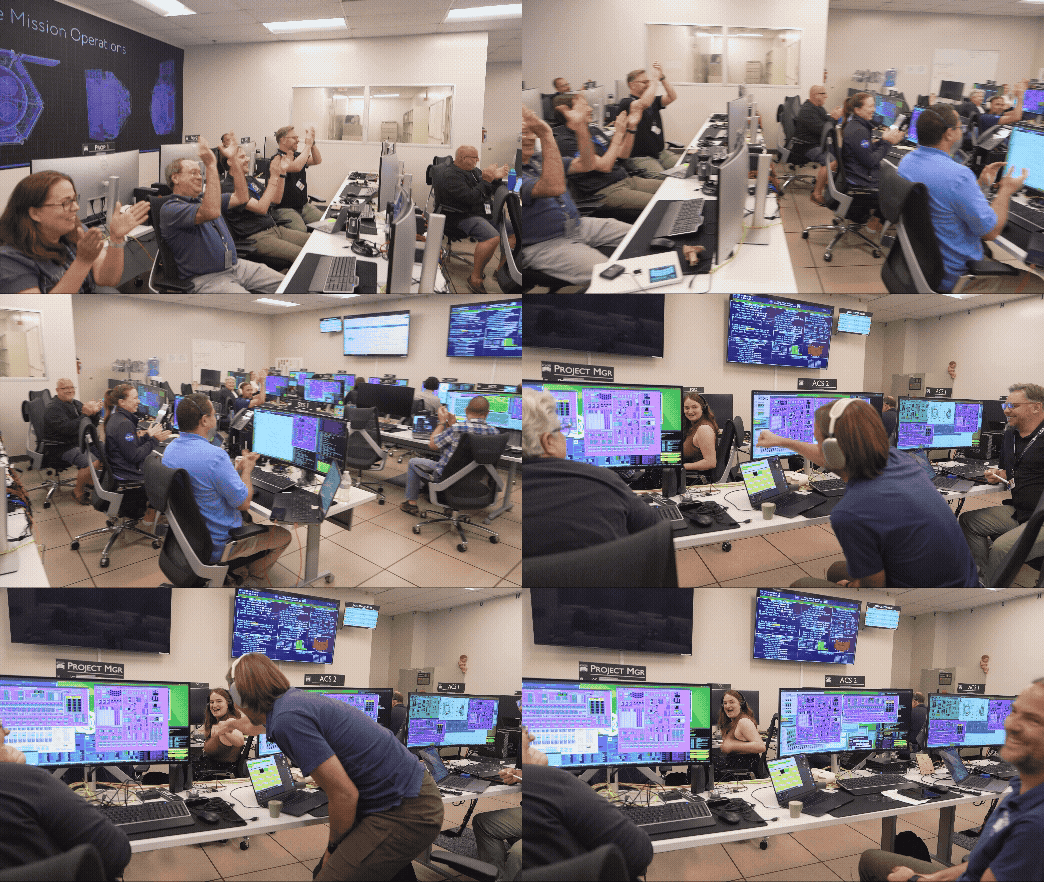
NASA Activates Roman’s Wide Field Instrument (WFI)
NASA’s Nancy Grace Roman Space Telescope team has successfully activated the Wide Field Instrument, a 300-megapixel infrared camera that will allow scientists to explore wide swaths of the cosmos very quickly without sacrificing exquisite detail.

Fuel Savings Double Potential Lifetime for NASA’s Roman Mission
The results are in: NASA’s Nancy Grace Roman Space Telescope’s very accurate first mid-course correction, along with other fuel savings, are expected to more than double the mission’s potential operational lifetime.
“As a result of exquisite planning by our orbital dynamics team, brilliant execution by the operations team, and a precise launch from SpaceX, Roman has fuel for at least 22 years of potential science operations,” said Jamie Dunn, center director at NASA’s Goddard Space Flight Center in Greenbelt, Maryland.
Roman Caught on Candid Camera
From community member Stephanie LaMassa: This is fun! During Live Astronomy at Dragon Con over Labor Day weekend, Bill Keel took a series of exposures of Roman as it’s journeying to L2. During Live Astro, Bill remotely controls a telescope at La Palma to observe fun things throughout the night (weather permitting) and then controls a telescope at Cerro Tololo later in the night (weather permitting) from the Space Track panel room while Roy Kilgard and I try to keep folks engaged with Q&A and other fun shenanigans while Bill is collecting data. (It turns out that watching a screen of GUIs to operate a telescope doesn’t make for exciting viewing.)
In the animation, you’ll see Roman transiting in front of an “otherwise anonymous galaxy KOS 222659.30215011” in Aquarius. Roman was 636,000 km away and at a magnitude of R=15.3. Bill took a series of 30 second exposures for a 10 minute total observation. I’m also including the trail image: an example of when we want satellite streaks in our images.


Roman Data Workshop at AAS249
Excited to get your hands dirty with Roman data? Then don't forget to sign-up for our workshop when you register for #AAS249 in Salt Lake City, UT:
Roman, JWST, TESS, Gaia, and More: Working with Big Data at MAST, Sunday, January 10, 2027 at 9am.

Adopt a Roman WFI Pixel
Claim your pixel on one of the first images! When Roman captures its first images, each pixel will represent a piece of the cosmos never seen before at this resolution. Claim your pixel and be part of this historic moment!
https://science.nasa.gov/mission/roman-space-telescope/adopt-a-pixel/

Have Something to Share or Promote? Submit Your Own Announcement
Roman is a community mission. To that end, we encourage you to share and submit your own announcements in our weekly newsletter. Please submit any request here.
Stay Connected and Up To Date
Excited about all the progress with Roman? Want to stay in the know? Now is the time to join the Roman community.
Follow us on social media @NancyRomanSci on Twitter, Blue Sky, Instagram, and Facebook.
If you are already part of the Roman community, please consider subscribing to our calendar to stay up to date, joining one of the new working groups, and contributing to Roman participation in AAS.
WOW! Roman has successfully launched and is on its way to L2 orbit. Here are some of my favorites.


Adopt a Roman WFI Pixel
Claim your pixel on one of the first images! When Roman captures its first images, each pixel will represent a piece of the cosmos never seen before at this resolution. Claim your pixel and be part of this historic moment!
https://science.nasa.gov/mission/roman-space-telescope/adopt-a-pixel/

Stay Up to Date with the Roman Blog and Commissioning Page
A lot will be happening with Roman as it deploys, enters L2 orbit, and begins commissioning. Get the latest information on the Roman Blog (hit subscribe): https://science.nasa.gov/blogs/roman/
For details about Roman's orbit, deployment, and commissioning plan, check out this interactive article: https://science.nasa.gov/missions/roman-space-telescope/roman-commissioning/
Tag #RomanLaunch On Social Media
Share and view your favorite launch photos on social media by using the #RomanLaunch hashtag. Don't forget to follow us on social media @NancyRomanSci on Twitter, Blue Sky, Instagram, and Facebook.

Roman Team Gathered One Last Time Before Launch
All science is GO for launch! Scientists came together in Cocoa Beach, FL, for the Roman Launch Science Meeting to share their plans for supporting a new era of discovery with Roman.
#RomanLaunch

Have Something to Share or Promote? Submit Your Own Announcement
Roman is a community mission. To that end, we encourage you to share and submit your own announcements in our weekly newsletter. Please submit any request here.
Stay Connected and Up To Date
Excited about all the progress with Roman? Want to stay in the know? Now is the time to join the Roman community.
Follow us on social media @NancyRomanSci on Twitter, Blue Sky, Instagram, and Facebook.
If you are already part of the Roman community, please consider subscribing to our calendar to stay up to date, joining one of the new working groups, and contributing to Roman participation in AAS.
I think we all know what this week in Roman is! But yes, this is the last post before launch. What a ride. It is truly a momentous occasion to be here. Thank you to everyone who has contributed, supported, and/or followed the mission along the way. Can't wait to see what comes next. Clear skies and GO ROMAN!
Social Media #RomanLaunch Hashtag
Our @NancyRomanSci will be using the #RomanLaunch hashtag throughout the launch. We encourage our community to use this hashtag as well!
Don't forget to follow us on social media @NancyRomanSci on Twitter, Blue Sky, Instagram, and Facebook.
Roman Blog During Launch Will be Frequently Updated
To stay up most up to date with happenings during launch, we encourage you to follow the Roman Blog: https://science.nasa.gov/blogs/roman/
Roman Team Gathers One Last Time Before Launch
All science is GO for launch! Scientists came together in Cocoa Beach, FL, for the Roman Launch Science Meeting to share their plans for supporting a new era of discovery with Roman.
#RomanLaunch

NASA’s Nancy Grace Roman Space Telescope Arrives at Hangar
NASA’s Nancy Grace Roman Space Telescope arrived Tuesday to the SpaceX hangar at Launch Complex 39A at Kennedy Space Center in Florida, just days before its scheduled launch.
Full story: https://science.nasa.gov/blogs/roman/2026/08/25/nasas-nancy-grace-roman-space-telescope-arrives-at-hangar/

"Shifting Landscapes" Recordings Now Online
Presentation videos from last month's Roman science conference "Shifting Landscapes" are now available online!
https://www.youtube.com/playlist?list=PLd0tYwyZN2Sc
Have Something to Share or Promote? Submit Your Own Announcement
Roman is a community mission. To that end, we encourage you to share and submit your own announcements in our weekly newsletter. Please submit any request here.
Stay Connected and Up To Date
Excited about all the progress with Roman? Want to stay in the know? Now is the time to join the Roman community.
Follow us on social media @NancyRomanSci on Twitter, Blue Sky, Instagram, and Facebook.
If you are already part of the Roman community, please consider subscribing to our calendar to stay up to date, joining one of the new working groups, and contributing to Roman participation in AAS.
"Shifting Landscapes" Recordings Now Online
Presentation videos from last month's Roman science conference "Shifting Landscapes" are now available online!
https://www.youtube.com/playlist?list=PLd0tYwyZN2Sc
Launch Dress Rehearsal Complete Ahead of NASA Roman Space Telescope Liftoff
The team preparing to launch NASA’s Nancy Grace Roman Space Telescope completed a mission dress rehearsal on Thursday from Florida’s space coast.

Have Something to Share or Promote? Submit Your Own Announcement
Roman is a community mission. To that end, we encourage you to share and submit your own announcements in our weekly newsletter. Please submit any request here.
Stay Connected and Up To Date
Excited about all the progress with Roman? Want to stay in the know? Now is the time to join the Roman community.
Follow us on social media @NancyRomanSci on Twitter, Blue Sky, Instagram, and Facebook.
If you are already part of the Roman community, please consider subscribing to our calendar to stay up to date, joining one of the new working groups, and contributing to Roman participation in AAS.
Next Roman Virtual Lecture Series on Thursday, August 20 2026 4:00-4:30 EDT/1:00-1:30 PDT
Our next Roman Virtual Lecture Series is on Thursday August 20, 2026 from 4-4:30 PM EDT/1-1:30 PM PDT.
Speaker:Andrew Benson (Carnegie Science)
Title: “Emulating Galacticus for the Roman Galaxy Redshift Survey”
The Roman Galaxy Redshift Survey will measure redshifts from slitless grism spectroscopy, and testing how reliably those redshifts can be extracted requires realistic simulated surveys - mock skies whose galaxy number densities, sizes, and emission-line strengths are right, not merely plausible. We build these by applying the Galacticus semi-analytic galaxy formation model to dark matter halo merger trees from the UNIT N-body simulations, and placing the resulting galaxies on a lightcone. This only works if Galacticus is calibrated against the observables that matter, and calibration is expensive: a single likelihood evaluation involving a stellar mass function requires evolving thousands of halos.
I will describe our approach to this problem. Building on an earlier fast-likelihood method that calibrates against the stellar-to-halo mass relation rather than the mass function directly, we now emulate Galacticus with Gaussian processes. From a 1024-point Latin hypercube spanning 20 model parameters, we train emulators — PCA-compressed, one Gaussian process per component — that predict stellar mass functions, star formation rate functions, sizes, and Hα luminosity functions in milliseconds, with calibrated uncertainties. Held-out tests show accuracies of 0.05–0.13 dex where the observational data lie. This makes simultaneous MCMC calibration against many datasets tractable, and reveals which observables constrain which parameters — including tensions between mass functions and galaxy sizes that point to genuine missing flexibility in the model physics rather than shortcomings of the fit. I will close with the status of the calibrated 16 deg² lightcone being delivered for the team's grism image simulations.
Call In Info: https://teams.microsoft.com/meet/278909753462200?p=FfQvEwPNYtn896iqSX
Roman Integrated into Payload
From Jeff Kruk: There are some nice new photos of Roman integrated to the payload attach fitting on the public NASA photo page: https://images.nasa.gov/album/SpaceX_Roman_Space_Telescope

Host Your Own Roman Launch or First Look Observations Event
The NASA Roman mission is partnering with NASA's Universe of Learning to share the excitement of Roman launch and first images with communities across the country. Roman Community Events is supporting host sites who want to tap into this excitement and host public events in their local communities. Some information provided to those interested in hosting an event are posted below:
With Roman’s launch around the corner, now is the perfect time to organize a compelling event in your community! Roman provides a real-world opportunity for audiences to connect to and engage with NASA science, and ultimately see the universe in a new way: through the lens of Roman’s large-scale and pattern-finding surveys. By bringing Roman science to your audience, they can explore some of the biggest, persisting mysteries about space. You can learn more about Roman, opportunities to host your own event, and Roman resources at the links below:
If your institution intends to host a Roman launch or First Look Observations event and you would like to have your event known and listed on the event map, here, there are two ways to sign up:
- Fill out this form: https://docs.google.com/forms/d/e/1FAIpQLSevySe6b1cywYSL4lOjXsR_xSc_5G9eay2V2EP9rm8uYxzmpA/viewform?linkId=982274078
- Send an email to Peter Sooy (peter.r.sooy@nasa.gov) or Brandon Lawton (lawton@stsci.edu)
MAST Summer Series Continues
The MAST Summer webinar series continues! This series is not specific to Roman, but will include a lot of useful tutorials that can be directly applicable to Roman data. We encourage you to tune in and find out.
Details and registration: https://archive.stsci.edu/contents/newsletters/april-2026/2026-summer-webinar

Have Something to Share or Promote? Submit Your Own Announcement
Roman is a community mission. To that end, we encourage you to share and submit your own announcements in our weekly newsletter. Please submit any request here.
Stay Connected and Up To Date
Excited about all the progress with Roman? Want to stay in the know? Now is the time to join the Roman community.
Follow us on social media @NancyRomanSci on Twitter, Blue Sky, Instagram, and Facebook.
If you are already part of the Roman community, please consider subscribing to our calendar to stay up to date, joining one of the new working groups, and contributing to Roman participation in AAS.
STScI's Deep Space Dialogues on Roman Scheduled for Tuesday, August 11 at 7pm EDT
Description
Speakers: Dr. Denton Gibson (NASA's Kennedy Space Center) and Dr. Jessica Lu (University of California, Berkeley)
The Nancy Grace Roman Space Telescope—NASA’s next astrophysics flagship mission— is slated to launch on August 30, 2026. Dr. Gibson, Launch Director with NASA's Launch Services Program, will discuss the engineering behind the telescope’s lift-off and the path to its final destination. Additionally, Dr. Lu will examine Roman’s science potential to survey the heart of our Milky Way galaxy and find a variety of objects—including isolated black holes—using innovative techniques.
Link with details: https://www.stsci.edu/contents/events/deep-space-dialogues/2026/nasas-nancy-grace-roman-space-telescope-countdown-to-exploration
Notes
This lecture will be presented with a livestream to YouTube, and questions can be asked in the YouTube chat. The recording will also be posted on our YouTube channel.

NASA Begins Fueling Roman
Roman is set to launch August 30 at 07:26 am EDT from NASA Kennedy Space Flight Center.
Technicians completed fueling NASA’s Nancy Grace Roman Space Telescope, bringing it an important step closer to launch. On July 25, the team completed operations that carefully loaded 290 gallons of hydrazine fuel into the observatory at the Payload Hazardous Servicing Facility at NASA’s Kennedy Space Center in Florida.
Full Story: https://science.nasa.gov/blogs/roman/2026/07/27/nasa-fuels-roman-space-telescope-for-late-august-launch/

Host Your Own Roman Launch or First Look Observations Event
The NASA Roman mission is partnering with NASA's Universe of Learning to share the excitement of Roman launch and first images with communities across the country. Roman Community Events is supporting host sites who want to tap into this excitement and host public events in their local communities. Some information provided to those interested in hosting an event are posted below:
With Roman’s launch around the corner, now is the perfect time to organize a compelling event in your community! Roman provides a real-world opportunity for audiences to connect to and engage with NASA science, and ultimately see the universe in a new way: through the lens of Roman’s large-scale and pattern-finding surveys. By bringing Roman science to your audience, they can explore some of the biggest, persisting mysteries about space. You can learn more about Roman, opportunities to host your own event, and Roman resources at the links below:
If your institution intends to host a Roman launch or First Look Observations event and you would like to have your event known and listed on the event map, here, there are two ways to sign up:
- Fill out this form: https://docs.google.com/forms/d/e/1FAIpQLSevySe6b1cywYSL4lOjXsR_xSc_5G9eay2V2EP9rm8uYxzmpA/viewform?linkId=982274078
- Send an email to Peter Sooy (peter.r.sooy@nasa.gov) or Brandon Lawton (lawton@stsci.edu)
MAST Summer Series Continues
The MAST Summer webinar series continues! This series is not specific to Roman, but will include a lot of useful tutorials that can be directly applicable to Roman data. We encourage you to tune in and find out.
Details and registration: https://archive.stsci.edu/contents/newsletters/april-2026/2026-summer-webinar

Have Something to Share or Promote? Submit Your Own Announcement
Roman is a community mission. To that end, we encourage you to share and submit your own announcements in our weekly newsletter. Please submit any request here.
Stay Connected and Up To Date
Excited about all the progress with Roman? Want to stay in the know? Now is the time to join the Roman community.
Follow us on social media @NancyRomanSci on Twitter, Blue Sky, Instagram, and Facebook.
If you are already part of the Roman community, please consider subscribing to our calendar to stay up to date, joining one of the new working groups, and contributing to Roman participation in AAS.
Host Your Own Roman Launch or First Look Observations Event
The NASA Roman mission is partnering with NASA's Universe of Learning to share the excitement of Roman launch and first images with communities across the country. Roman Community Events is supporting host sites who want to tap into this excitement and host public events in their local communities. Some information provided to those interested in hosting an event are posted below:
With Roman’s launch around the corner, now is the perfect time to organize a compelling event in your community! Roman provides a real-world opportunity for audiences to connect to and engage with NASA science, and ultimately see the universe in a new way: through the lens of Roman’s large-scale and pattern-finding surveys. By bringing Roman science to your audience, they can explore some of the biggest, persisting mysteries about space. You can learn more about Roman, opportunities to host your own event, and Roman resources at the links below:
If your institution intends to host a Roman launch or First Look Observations event and you would like to have your event known and listed on the event map, here, there are two ways to sign up:
- Fill out this form: https://docs.google.com/forms/d/e/1FAIpQLSevySe6b1cywYSL4lOjXsR_xSc_5G9eay2V2EP9rm8uYxzmpA/viewform?linkId=982274078
- Send an email to Peter Sooy (peter.r.sooy@nasa.gov) or Brandon Lawton (lawton@stsci.edu)
Telescope Milestone: Teams Check Out NASA Roman Solar Panels
The solar panels that will help power NASA’s Nancy Grace Roman Telescope completed prelaunch cleaning and inspections July 8 at the Payload Hazardous Servicing Facility at NASA’s Kennedy Space Center in Florida.
Full story here: https://science.nasa.gov/blogs/roman/2026/07/16/telescope-milestone-teams-check-out-nasa-roman-solar-panels/

Press Release: NASA’s Roman Launch Preparations Proceed
With less than two months until the launch of NASA’s Nancy Grace Roman Space Telescope, engineers at NASA’s Kennedy Space Center in Florida are preparing the observatory for its trip to space.
Full story: https://science.nasa.gov/blogs/roman/2026/07/09/nasas-roman-launch-preparations-proceed/


Press Release: NASA’s Roman Telescope Will Spot Distant Black Holes That Shred Stars
How do black holes at the center of galaxies form and grow over time? To answer this question, scientists need to detect and study supermassive black holes at great distances, which existed much earlier in the universe’s history. New research suggests NASA’s Nancy Grace Roman Space Telescope, which is on track to launch Aug. 30, 2026, will be able to detect these distant, ancient black holes that existed up to 11 billion years ago.
“The Roman Space Telescope is going to be transformative for transient science,” said lead author Mitchell Karmen of the Johns Hopkins University, a graduate student and National Science Foundation Graduate Research Fellow. “Thanks to Roman’s high sensitivity, we can find multiple tidal disruption events out to greater distances and earlier cosmic times than ever before.”

Cycle 1 Proposal Results
Following the review of 374 submitted proposals, the Roman Science Support Center is pleased to announce the 118 approved programs for the inaugural Roman Cycle 1 General Investigator Program.
Reflecting Roman’s focus on community-driven exploration of its expansive datasets, the vast majority of the selected programs are dedicated to data analysis, theoretical investigations, and laboratory astrophysics. The selections include:
61 Small, 45 Medium, and 12 Large programs.
Of these, five programs request General Astrophysics Surveys, utilizing a total of 1,456 hours of telescope time. The Cycle 1 proposals oversubscribed the funding allocation by a factor of 4.5 and the available hours by a factor of 10.
The science spans a diverse array of topics, broadly ranging from the solar system to large scale structure.

We extend our deep gratitude to the reviewers and Telescope Allocation Committee members for their time and expertise.
Full list of approved programs: https://roman.ipac.caltech.edu/cycle1-approved-programs
MAST Summer Series Continues
The MAST Summer webinar series continues! This series is not specific to Roman, but will include a lot of useful tutorials that can be directly applicable to Roman data. We encourage you to tune in and find out.
Details and registration: https://archive.stsci.edu/contents/newsletters/april-2026/2026-summer-webinar

Have Something to Share or Promote? Submit Your Own Announcement
Roman is a community mission. To that end, we encourage you to share and submit your own announcements in our weekly newsletter. Please submit any request here.
Stay Connected and Up To Date
Excited about all the progress with Roman? Want to stay in the know? Now is the time to join the Roman community.
Follow us on social media @NancyRomanSci on Twitter, Blue Sky, Instagram, and Facebook.
If you are already part of the Roman community, please consider subscribing to our calendar to stay up to date, joining one of the new working groups, and contributing to Roman participation in AAS.
